Mapping the Future Pharmacist: A National Cross-Sectional Study on Iraqi Students' Career Intentions and Influencing Factors
Keywords:
Iraq, Motivation, Pharmacy educationAbstract
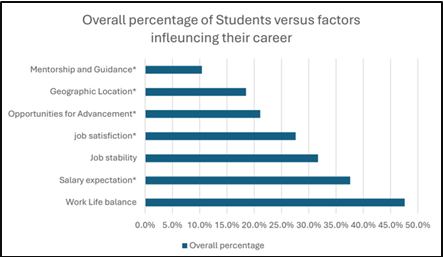
Background: The rapid expansion of pharmacy education in Iraq has produced a growing cohort of graduates with diverse career goals and motivations. Understanding the determinants of their career choices is critical for aligning educational outcomes with national healthcare workforce needs. Objective: To explore the perspectives of pharmacy students regarding their future careers and to identify the major factors influencing their decision to pursue pharmacy education. Methods: A cross-sectional, hybrid methods survey was conducted among 508 students from public and private pharmacy colleges across Iraq. A validated self-administered questionnaire collected data on demographics, influences on career choice, professional aspirations, and confidence levels regarding career readiness. Results: Most respondents were female (65.7%), and the majority (84.8%) were enrolled in private colleges. The principal motivations for choosing pharmacy were an interest in healthcare (46.4%), family influence (35.6%), and job security (20.8%). Community and clinical pharmacy emerged as the most preferred career paths (26.2% each), followed by hospital pharmacy (17.1%). Work-life balance (47.4%) and salary expectations (37.4%) were the dominant factors affecting career choice. Furthermore, 40.9% of students intended to pursue postgraduate education immediately, and 44.3% planned to do so later, indicating a strong inclination toward continuous professional development. Conclusions: Iraqi pharmacy students demonstrate a strong commitment to patient-oriented roles and lifelong learning yet face uncertainty about career preparedness and limited awareness of non-traditional pharmacy fields such as regulatory affairs. The findings suggest enhanced career counseling, experiential learning, and curriculum alignment to support well-informed career decisions and workforce sustainability.
References
1. Arbab AH, Eltahir YAM, Elsadig FS, Yousef BA. Career Preference and Factors Influencing Career Choice among Undergraduate Pharmacy Students at University of Khartoum, Sudan. Pharmacy. 2022;10(1). doi: 10.3390/pharmacy10010026.
2. Crass RL, Romanelli F. Curricular reform in pharmacy education through the lens of the flexner report of 1910. Am J Pharm Edu. 2018. doi: 10.5688/AJPE6804.
3. Alharbi NS, Al-Habas SM, Al-Habas SM, Alsharekh AAS, Al Bawardi S, Al-Nasser NS, et al. Pharmaceutical sciences and social dynamics: bridging medication practices, public health challenges, and everyday lives. Int J Health Sci (Qassim). 2024;8(S1). doi: 10.53730/ijhs.v8ns1.15371.
4. Sanii Y, Torkamandi H, Gholami K, Hadavand N, Javadi M. Role of pharmacist counseling in pharmacotherapy quality improvement. J Res Pharm Pract. 2016;5(2). doi: 10.4103/2279-042x.179580.
5. World Health Organization. Developing pharmacy practice: A focus on patient care: Handbook. 2006.
6. Mayimele N, Demana P, Keele M. An assessment of positions, perceptions and valued leadership competencies of pharmacists that work in manufacturing pharmaceutical companies (MPCs) in South Africa. SocioEconomic Challenges. 2023;7(4). doi: 10.61093/sec.7(4).66-79.2023.
7. Mohammed SI, Hameed AM, Ali FZ, Khazaal TQ. Physician and Medical Representative Interaction in Iraqi Private Sector: A Qualitative Study. Iraqi J Pharm Sci. 2024. doi: 10.31351/vol33iss(4SI)pp1-11.
8. Ibrahim IR, Wayyes AR. Pharmacy Practice in Iraq. In: Pharmacy Practice in Developing Countries. Elsevier; 2016. p. 199–210. doi: 10.1016/B978-0-12-801714-2.00010-1
9. Zhang T, Li L, Bian Y. Final-year pharmacy undergraduate students’ career intention and its influencing factors: a questionnaire study in northwest China. BMC Med Educ. 2020;20(1). doi: 10.1186/s12909-020-02342-8.
10. El-Hammadi M. Career preferences of Syrian students and their attitudes toward a number of practice areas: Will community pharmacy continue to dominate the profession? Curr Pharm Teach Learn. 2013;5(5). doi: 10.1016/j.cptl.2013.03.004.
11. Song C, Glick JE. College attendance and choice of college majors among Asian American students. Soc Sci Quarterly. 2004. doi: 10.1111/j.0038-4941.2004.00283.x.
12. Hovenden A, O’Shea JP, Bennett-Lenane H. Factors affecting pharmacy student career intentions across patient-facing and non-patient facing settings: A cross-sectional evaluation. Curr Pharm Teach Learn. 2025;17(9). doi: 10.1016/j.cptl.2025.102408.
13. Ahmed F, Al-Jumaili AJ. Evaluation of career goals among Iraqi pharmacy students. ResearchgateNet. 2021;(March).
14. Agreement to Launch Medical Group Recruitment Next June. Al-Zaman Newspaper [Internet]. 2025 May [cited 2026 Jan 29]. Available from: https://www.azzaman-iraq.com/content.php?id=104957&html
15. NBA News. Pharmacists’ Syndicate: No employment and no membership after 2024. NBA News [Internet]. 2021 [cited 2026 Jan 29]. Available from: https://www.nbanews.net/arabic/1mQ7O9_8
16. Mukattash TL, Nuseir KQ, Biltaji E, Jarab AS, Alefan Q. Students’ perceptions of pharmacy as a specialization and their future career, a cross sectional study of final year pharmacy students in Jordan. Jordan J Pharm Sci. 2015;8(3). doi: 10.12816/0030450.
17. Aburuz S, Al-Ghazawi M, Snyder A. Pharmaceutical care in a community-based practice setting in Jordan: Where are we now with our attitudes and perceived barriers? Int J Pharmacy Pract. 2012;20(2). doi: 10.1111/j.2042-7174.2011.00164.x.
18. Al-Wazaify M, Albsoul-Younes A, Hakooz N. Improving pharmacy education at the public faculties of pharmacy in Jordan: Student’s experience and expectations. Pharmacy Educ. 2010;10(2).
19. El Hajj MS, Hammad AS, Afifi HM. Pharmacy students’ attitudes toward pharmaceutical care in Qatar. Ther Clin Risk Manag. 2014;10(1). doi: 10.2147/TCRM.S56982.
20. Alhomoud FK, AlGhalawin L, AlGofari G, AlDjani W, Ameer A, Alhomoud F. Career Choices and Preferences of Saudi Pharmacy Undergraduates: A Cross Sectional Study. Saudi Pharm J. 2019;27(4). doi: 10.1016/j.jsps.2019.01.009.
21. The pharmacists’ union calls for a two-hour work stoppage and threatens escalating measures. Al-Mada Newspaper [Internet]. 2026 Jun 13 [cited 2026 Jun 18]. Available from: https://almadapaper.net/438964/
22. Parliamentary Health Committee: The surplus of dentists and pharmacists reaches 100%. Today Agency [Internet]. 2024 May 23 [cited 2026 Jun 18]. Available from: https://today-agency.net/Details/12053
23. Alhemadey H, Mousnad MA, Saeed AA, Hamid A. Sudanese pharmacy students: career intentions, expectations and factors affecting their choices. Universal J Pharm Res. 2021. doi: 10.22270/ujpr.v5i6.505.
24. Ayyash MA, Nassar RI, Al-Muhtaseb R, Jaber KA. Drug regulatory affairs under focus: Knowledge and perceptions among pharmacists and pharmacy students. PLoS One. 2025;20(3). doi: 10.1371/journal.pone.0320599.
25. Paricharak S, Baravkar A, Masal A, Chougule S, Deshmane P, Kulkarni S. A comprehensive synopsis on cognizance of Regulatory Affairs in different sectors of Pharmacy. Int J Drug Regulat Affairs. 2021;9(4). doi: 10.22270/ijdra.v9i4.495.
26. Pravallika P, Ramadoss V, Audinarayana N. A comprehensive examination of regulatory affairs awareness in several pharmacy industries. Int J Res Pharm Sci. 2025;16(2). doi: 10.26452/ijrps.v16i2.4777.
27. Abu-Gharbieh E, Fahmy S, Rasool BA, Abduelkarem A, Basheti I. Attitudes and perceptions of healthcare providers and medical students towards clinical pharmacy services in United Arab Emirates. Tropic J Pharm Res. 2010;9(5). doi: 10.4314/tjpr.v9i5.61050.
28. Ministry of Health [Internet]. [cited 2026 Jun 18]. To support and localize the pharmaceutical industry, a team from the Ministry of Health is monitoring the work of pharmaceutical factories in Baghdad. Available from: https://moh.gov.iq/?article=11401
29. College of Pharmacy, University of Baghdad. Establishment of a Higher Professional Diploma Program in Industrial Pharmacy [cited 2026 Jun 24]. Available from: https://en.copharm.uobaghdad.edu.iq/?p=11235
30. Alhemadey H, Mousnad MA, Saeed AA, Hamid A. Sudanese pharmacy students: career intentions, expectations and factors affecting their choices. Universal J Pharm Res. 2021. doi: 10.22270/ujpr.v5i6.505.
31. Factors Affecting University Graduates’ Employability in Egypt Using Egyptian University Students as a Case Study. SAE [Internet]. 2023 May 15 [cited 2026 Jun 24];41(2). Available from: https://ojs.ual.es/ojs/index.php/eea/article/view/8731
32. Kıran B, Karaca EG, Baliç B. Determining levels of unemployment anxiety among pharmacy students at Ege University. J Res Pharm. 2025;26(4):1016–1024. Available at: https://izlik.org/JA54XN79WY
33. Fitzpatrick KL, Allen EA, Griffin BT, O’Shea JP, Dalton K, Bennett-Lenane H. Exploring career choices of pharmacy graduates over 15 years: a cross-sectional evaluation. Curr Pharm Teach Learn. 2024;16(5):307–318. doi: 10.1016/j.cptl.2024.02.010.
34. Abuhammad S, Alzoubi KH, Al-Azzam S, Karasneh R, Masadeh MM, Alameddine M. Work-life balance, job satisfaction, and burnout among nurses in Jordan: A cross-sectional study. PloS One. 2025;20(10):e0334603. doi: 10.1371/journal.pone.0334603.
35. Alhomoud IS, Alrasheedy AA. Prevalence and Factors Associated with Burnout among Community Pharmacists in Saudi Arabia: Findings and Implications. Healthcare (Basel). 2024;12(18):1834. doi: 10.3390/healthcare12181834.
36. Alhomoud FK, Basil M, Bondarev A. Factors influencing career choice among undergraduate pharmacy students at a private university in Jordan. Pharmacy Educ. 2019;19(1):56–61. Available at: https://pharmacyeducation.fip.org/pharmacyeducation/article/view/631
Downloads
Published
Issue
Section
License
Copyright (c) 2026 The Journal of Iraqi Society of Pharmaceutical Sciences

This work is licensed under a Creative Commons Attribution-NonCommercial-ShareAlike 4.0 International License.

