Phytochemical Analysis and Antioxidant Activity of Mentha piperita L. (Peppermint) from Iraq
Keywords:
DPPH , GC-FID , Mentha piperita L. , Phenolic quantification , Phytochemistry , RP-HPLCAbstract
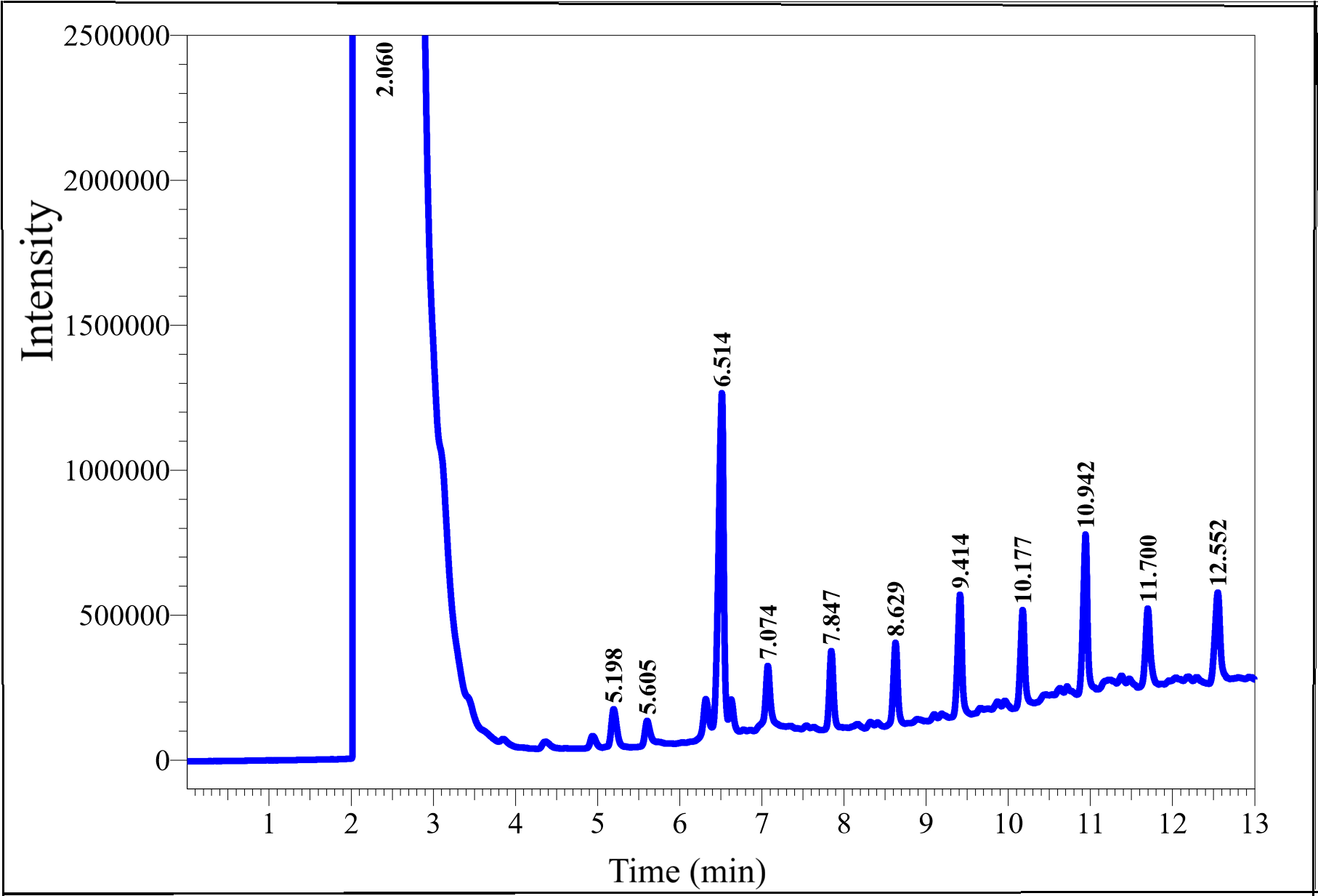
Background: Mentha piperita L. (Lamiaceae) owes its pharmacological reputation to two chemically distinct fractions, a non-volatile phenolic pool and a volatile essential oil. These are seldom characterized within the same study, and no phytochemical data appear to exist for material of Iraqi origin. Methods: Dried aerial parts of Iraqi origin, obtained from a laboratory plant collection, were macerated in parallel in ethanol and ethyl acetate (50.5 g/500 mL, 72 h, 25±2°C). Seven phenolic compounds were quantified by RP-HPLC (C18-ODS column, UV 220 nm) against certified reference standards. Essential oil recovered by Clevenger hydrodistillation (3 h) was profiled by GC-FID (ZB-1 column, 30 m). Antioxidant capacity was assessed by DPPH radical scavenging (30–500 ppm) against ascorbic acid, with IC50 derived by log-linear regression (n=3). Results: Gallic acid was the most abundant phenolic (74.90 μg/mL in ethanol; 70.22 in ethyl acetate), followed by quercetin (62.55; 55.99), rutin (40.12; 51.44), caffeic acid (34.55; 44.14), ferulic acid (20.33; 32.69), apigenin (14.15; 27.74) and kaempferol (9.15; 19.88 μg/mL). Menthol (47.22%) and menthone (15.14%) dominated the oil, with six identified constituents accounting for 74.49% of total peak area. Both extracts surpassed ascorbic acid in radical scavenging: IC50 74.48 ppm for the ethanolic extract (1.61-fold, p=0.0041) and 86.68 ppm for the ethyl acetate extract (1.38-fold, p=0.0157). Conclusions: Antioxidant activity tracked the identity of individual phenolics, chiefly gallic acid and quercetin, rather than total phenolic content. The values reported are analytical replicates from a single batch and require confirmation across independent batches.
References
1. World Health Organisation. WHO Traditional Medicine Strategy 2014–2023. Geneva: WHO Press; 2013.
2. Jones WP, Chin YW, Kinghorn AD. The role of pharmacognosy in modern medicine and pharmacy. Curr Drug Targets. 2006;7(3):247–264. doi: 10.2174/138945006775541693.
3. Antimicrobial Resistance Collaborators. Global burden of bacterial antimicrobial resistance in 2019: a systematic analysis. Lancet. 2022;399(10325):629–655. doi: 10.1016/S0140-6736(21)02724-0.
4. Lawrence BM. Mint: The Genus Mentha. Boca Raton: CRC Press; 2007.
5. McKay DL, Blumberg JB. A review of the bioactivity and potential health benefits of peppermint tea (Mentha piperita L.). Phytother Res. 2006;20(8):619–633. doi: 10.1002/ptr.1936.
6. Loolaie M, Moasefi N, Rasouli H, Adibi H. Peppermint and its functionality: a review. Arch Clin Microbiol. 2017;8(4):54.
7. Mikaili P, Mojaverrostami S, Moloudizargari M, Aghajanshakeri S. Pharmacological and therapeutic effects of Mentha longifolia L. and its main constituent, menthol. Anc Sci Life. 2013;33(2):131–138. doi: 10.4103/0257-7941.139059.
8. Sroka Z, Cisowski W. Hydrogen peroxide scavenging, antioxidant and anti-radical activity of some phenolic acids. Food Chem Toxicol. 2003;41(6):753–758. doi: 10.1016/S0278-6915(02)00329-0.
9. Dorman HJD, Kosar M, Kahlos K, Holm Y, Hiltunen R. Antioxidant properties and composition of aqueous extracts from Mentha species, hybrids, varieties, and cultivars. J Agric Food Chem. 2003;51(16):4563–4569. doi: 10.1021/jf034108k.
10. Dhifi W, Bellili S, Jazi S, Bahloul N, Mnif W. Essential oils' chemical characterization and investigation of some biological activities: a critical review. Medicines. 2016;3(4):25. doi: 10.3390/medicines3040025.
11. Juergens UR. Anti-inflammatory properties of the monoterpene 1,8-cineole: current evidence for co-medication in inflammatory airway diseases. Drug Res. 2014;64(12):638–646. doi: 10.1055/s-0034-1372609.
12. Mimica-Dukic N, Bozin B, Sokovic M, Mihajlovic B, Matavulj M. Antimicrobial and antioxidant activities of three Mentha species essential oils. Planta Med. 2003;69(5):413–419. doi: 10.1055/s-2003-39704.
13. Hussain AI, Anwar F, Nigam PS, Ashraf M, Gilani AH. Seasonal variation in content, chemical composition and antimicrobial and cytotoxic activities of essential oils from four Mentha species. J Sci Food Agric. 2010;90(11):1827–1836. doi: 10.1002/jsfa.4021.
14. Lawrence BM. A planning scheme to evaluate new aromatic plants for the flavour and fragrance industries. In: Janick J, Simon JE, eds. New Crops. New York: Wiley; 1993:620–627.
15. European Pharmacopoeia Commission. European Pharmacopoeia, 11th edition. Strasbourg: Council of Europe; 2022.
16. Adams RP. Identification of Essential Oil Components by Gas Chromatography/Mass Spectrometry. 4th edition. Carol Stream: Allured Publishing; 2007.
17. Molyneux P. The use of the stable free radical diphenylpicrylhydrazyl (DPPH) for estimating antioxidant activity. Songklanakarin J Sci Technol. 2004;26(2):211–219.
18. Nilo MCS, Riachi LG, Simas DLR, et al. Chemical composition and antioxidant and antifungal properties of Mentha piperita L. and Mentha arvensis L. Food Res. 2017;1(5):147–156. doi: 10.26656/fr.2017.1(5).055.
19. Do QD, Angkawijaya AE, Tran-Nguyen PL, Huynh LH, Soetaredjo FE, Ismadji S, et al. Effect of extraction solvent on total phenol content, total flavonoid content, and antioxidant activity of Limnophila aromatica. J Food Drug Anal. 2014;22(3):296–302. doi: 10.1016/j.jfda.2013.11.001.
20. Kahkeshani N, Farzaei F, Fotouhi M, Alavi SS, Bahramsoltani R, Naseri R, et al. Pharmacological effects of gallic acid in health and diseases: a mechanistic review. Iran J Basic Med Sci. 2019;22(3):225–237. doi: 10.22038/ijbms.2019.32806.7897.
21. Li Y, Yao J, Han C, Yang J, Chaudhry MT, Wang S, et al. Quercetin, inflammation and immunity. Nutrients. 2016;8(3):167. doi: 10.3390/nu8030167.
22. Ou S, Kwok KC. Ferulic acid: pharmaceutical functions, preparation and applications in foods. J Sci Food Agric. 2004;84(11):1261–1269. doi: 10.1002/jsfa.1873.
23. Espindola KMM, Ferreira RG, Neto LEM, Nonato CF, Albuquerque RS, Monteiro MC. Chemical and pharmacological aspects of caffeic acid and its activity in hepatocarcinoma. Front Oncol. 2019;9:541. doi: 10.3389/fonc.2019.00541.
24. Shukla S, Gupta S. Apigenin: a promising molecule for cancer prevention. Pharm Res. 2010;27(6):962–978. doi: 10.1007/s11095-010-0089-7.
25. Ganeshpurkar A, Saluja AK. The pharmacological potential of rutin. Saudi Pharm J. 2017;25(2):149–164. doi: 10.1016/j.jsps.2016.04.025.
26. Calderon-Montano JM, Burgos-Moron E, Perez-Guerrero C, Lopez-Lazaro M. A review on the dietary flavonoid kaempferol. Mini Rev Med Chem. 2011;11(4):298–344. doi: 10.2174/138955711795305335.
27. Brahmi F, Abdennacer B, Rachid D, Faouzi M, Nabil M. Chemical composition and biological activities of Mentha x piperita L. essential oil with emphasis on the antimicrobial activity. Eur J Integr Med. 2016;8(6):948–956. doi: 10.1016/j.eujim.2016.09.004.
28. Tassou CC, Koutsoumanis K, Nychas GJE. Inhibition of Salmonella enteritidis and Staphylococcus aureus in nutrient broth by mint essential oil. Food Res Int. 2000;33(3):273–280. doi: 10.1016/S0963-9969(00)00047-8.
29. Sun J. D-limonene: safety and clinical applications. Altern Med Rev. 2007;12(3):259–264.
30. Linck VM, da Silva AL, Figueiro M, Caramao EB, Morrone LA, Cechinel-Filho V, et al. Effects of inhaled linalool in anxiety, social interaction and aggressive behaviour in mice. Phytomedicine. 2010;17(8-9):679–683. doi: 10.1016/j.phymed.2009.10.002.
31. Chen W, Viljoen AM. Geraniol — a review of a commercially important fragrance material. S Afr J Bot. 2010;76(4):643–651. doi: 10.1016/j.sajb.2010.05.008.
32. Dai J, Mumper RJ. Plant phenolics: extraction, analysis and their antioxidant and anticancer properties. Molecules. 2010;15(10):7313–7352. doi: 10.3390/molecules15107313.
Downloads
Published
Issue
Section
License
Copyright (c) 2026 The Journal of Iraqi Society of Pharmaceutical Sciences

This work is licensed under a Creative Commons Attribution-NonCommercial-ShareAlike 4.0 International License.

