HPLC Analysis and Antioxidant Activity of Ethanol and Chloroform Extracts of Syzygium aromaticum (L.)
Keywords:
Antioxidant activity, Chloroform extract, Ethanol extractAbstract
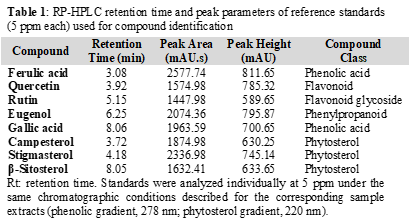
Background: Pharmacologically different phenolic and phytosterol fractions from clove (Syzygium aromaticum L.) buds. A lot of the literature deals with clove chemistry, but no concomitant characterization of both compound classes in Iraqi material has been reported. Objectives: Profile of phenolic and phytosterol constituents of Baghdad-sourced clove by RP-HPLC and comparison of antioxidant activity of ethanol and chloroform extracts by DPPH assay. Methods: Dried buds were separately macerated with ethanol and chloroform (1:4 w/v, 72 h, 25 ± 2 °C) and analyzed on a C18-ODS column (SYKAM; 278 nm phenolics / 220 nm phytosterols). Identity was determined by matching retention time (±0.1 min) with Sigma-Aldrich standards (MSI Level 2; ICH Q2(R2)). Results: The ethanolic extract (6.2% w/w) gave eugenol, ferulic acid, quercetin, rutin, and gallic acid, while the chloroform extract (8.8% w/w) yielded stigmasterol, campesterol, and β-sitosterol only. The ethanolic IC50 was higher than that of ascorbic acid (112.5±4.1 ppm, p<0.01), and the chloroform extract was significantly less active (284.7±9.2 ppm, p<0.001). Conclusions: Ethanol extracts a polyphenol-rich antioxidant fraction; chloroform isolates a therapeutically complementary phytosterol-rich fraction. These results represent the first combined phenolic-phytosterol characterization of Iraqi Syzygium aromaticum.
References
1. Newman DJ, Cragg GM. Natural products as sources of new drugs over the nearly four decades from 01/1981 to 09/2019. J Nat Prod. 2020;83(3):770–803. doi:10.1021/acs.jnatprod.9b01285
2. Allard PM, Bisson J, Azzollini A, Pauli GF, Cordell GA, Wolfender JL. Pharmacognosy in the digital era: shifting to contextualized metabolomics. Curr Opin Biotechnol. 2018;54:57–64. doi: 10.1016/j.copbio.2018.02.010.
3. Munteanu IG, Apetrei C. Analytical methods used in determining antioxidant activity: a review. Int J Mol Sci. 2021;22(7):3380. doi: 10.3390/ijms22073380.
4. Mohamed AA, Alotaibi BM. Essential oils of some medicinal plants and their biological activities: a mini review. J Umm Al-Qura Univ Appl Sci. 2023;9(1):40–49. doi: 10.1007/s43994-022-00018-1.
5. Dar RA, Shahnawaz M, Ahanger MA, Majid IU. Exploring the diverse bioactive compounds from medicinal plants: a review. J Phytopharm. 2023;12(3):189–195. doi: 10.31254/phyto.2023.12307.
6. Nwozo OS, Effiong EM, Aja PM, Awuchi CG. Antioxidant, phytochemical, and therapeutic properties of medicinal plants: a review. Int J Food Prop. 2023;26(1):359–388. doi: 10.1080/10942912.2022.2157425.
7. El-Saber Batiha G, Alkazmi LM, Wasef LG, Beshbishy AM, Nadwa EH, Rashwan EK. Syzygium aromaticum (L.) Merr. & L.M. Perry: traditional uses, bioactive chemical constituents, pharmacological and toxicological activities. Biomolecules. 2020;10(2):202. doi: 10.3390/biom10020202.
8. Haro-González JN, Castillo-Herrera GA, Martínez-Velázquez M, Espinosa-Andrews H. Clove essential oil (Syzygium aromaticum L. Myrtaceae): extraction, chemical composition, food applications, and essential bioactivity for human health. Molecules. 2021;26(21):6387. doi: 10.3390/molecules26216387.
9. Xue Q, Zhang M, Li Y, Liu Y, Wang X. Recent advances in nutritional composition, phytochemistry, bioactive properties, and potential applications of Syzygium aromaticum (L.) Merr. & L.M. Perry. Front Nutr. 2022;9:1002147. doi: 10.3389/fnut.2022.1002147.
10. Cortés-Rojas DF, de Souza CR, Oliveira WP. Clove (Syzygium aromaticum): a precious spice. Asian Pac J Trop Biomed. 2014;4(2):90–96. doi: 10.1016/S2221-1691(14)60215-X.
11. Mittal M, Gupta N, Parashar P, Mehra V, Khatri M. Phytochemical evaluation and pharmacological activity of Syzygium aromaticum: a comprehensive review. Int J Pharm Pharm Sci. 2014;6(8):67–72.
12. Kamatou GP, Vermaak I, Viljoen AM. Eugenol — from the remote Maluku Islands to the international market place: a review of a remarkable and versatile molecule. Molecules. 2012;17(6):6953–6981. doi: 10.3390/molecules17066953.
13. Nejad SM, Özgüneş H, Başaran N. Pharmacological and toxicological properties of eugenol. Turk J Pharm Sci. 2017;14(2):201–206. doi: 10.4274/tjps.62207.
14. Pramod K, Ansari SH, Ali J. Eugenol: a natural compound with versatile pharmacological actions. Nat Prod Commun. 2010;5(12):1999–2006. doi: 10.1177/1934578X1000501236.
15. Badhani B, Sharma N, Kakkar R. Gallic acid: a versatile antioxidant with promising therapeutic and industrial applications. RSC Adv. 2015;5(35):27540–27557. doi: 10.1039/C5RA01911G.
16. Kahkeshani N, Farzaei F, Fotouhi M, Alavi SS, Bahramsoltani R, Naseri R, et al. Pharmacological effects of gallic acid in health and disease: a mechanistic review. Iran J Basic Med Sci. 2019;22(3):225–237. doi: 10.22038/ijbms.2019.32806.7897.
17. Zduńska K, Dana A, Kolodziejczak A, Rotsztejn H. Antioxidant properties of ferulic acid and its possible application. Skin Pharmacol Physiol. 2018;31(6):332–336. doi: 10.1159/000491755.
18. Xu D, Hu MJ, Wang YQ, Cui YL. Antioxidant activities of quercetin and its complexes for medicinal application. Molecules. 2019;24(6):1123. doi: 10.3390/molecules24061123.
19. Ganeshpurkar A, Saluja AK. The pharmacological potential of rutin. Saudi Pharm J. 2017;25(2):149–164. doi: 10.1016/j.jsps.2016.04.025.
20. Brand-Williams W, Cuvelier ME, Berset C. Use of a free radical method to evaluate antioxidant activity. LWT Food Sci Technol. 1995;28(1):25–30. doi: 10.1016/S0023-6438(95)80008-5.
21. Salehi B, Quispe C, Sharifi-Rad J, Cruz-Martins N, Nigam M, Mishra AP, et al. Phytosterols: from preclinical evidence to potential clinical applications. Front Pharmacol. 2021;11:599959. doi: 10.3389/fphar.2020.599959.
22. Bin Sayeed MS, Karim SMR, Sharmin T, Morshed MM. Critical analysis on characterization, systemic effect, and therapeutic potential of beta-sitosterol: a plant-derived orphan phytosterol. Medicines. 2016;3(4):29. doi: 10.3390/medicines3040029.
Downloads
Published
Issue
Section
License
Copyright (c) 2026 The Journal of Iraqi Society of Pharmaceutical Sciences

This work is licensed under a Creative Commons Attribution-NonCommercial-ShareAlike 4.0 International License.

